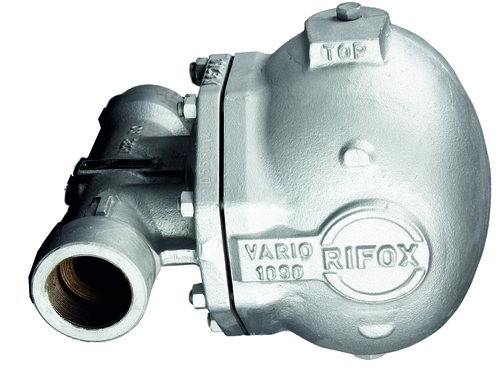
About Ball Float Trap
A steam trap is an automatic valve which closes to trap steam & opens to discharge condensate, air & noncondensable
gases from the steam system. The RIFOmat-Vario float controlled steam trap is an ideal choice for removal
of condensate at all process industries, sugar industry, refinery & petrochemicals. Application of this trap is for shell &
tube heat exchangers, evaporators & reboilers.
Versatility and Robust DesignBall Float Traps are crafted for demanding industrial environments, handling pressures up to 16 bar and temperatures of 220C. Their robust construction-offered in cast iron, stainless steel, and other durable materials-ensures long-lasting performance in steam and condensate lines. With both screwed and flanged connection options, they easily adapt to existing infrastructure, maximizing compatibility and installation ease.
High Performance and Easy MaintenanceEquipped with a stainless steel float and designed for silent, efficient operation, these traps deliver consistent discharge capacities up to 2000 kg/hr based on model. Their corrosion-resistant features, combined with easy-to-replace internals, minimize downtime and make routine maintenance straightforward and economical.
Wide Applications in IndustrySuitable for steam lines, process equipment, and condensate removal, Ball Float Traps are ideal for industries requiring reliable steam management. Available in several end connection sizes and orientations, they are tailored to meet the diverse operational demands of manufacturing, chemical processing, food and beverage, and more.
FAQ's of Ball Float Trap:
Q: How does a Ball Float Trap operate in a steam system?
A: A Ball Float Trap uses a stainless steel float that rises and falls with the condensate level inside the trap. As condensate enters, the float lifts, opening a valve to discharge condensate while retaining steam. This mechanical operation ensures efficient and automatic condensate removal from steam lines and equipment.
Q: What are the benefits of using Ball Float Traps with stainless steel floats?
A: Stainless steel floats offer excellent corrosion resistance and durability, which enhance the trap's lifespan and reliability. This material choice ensures consistent operation even in harsh industrial environments, ensuring minimal breakdowns and maintenance needs.
Q: When should I choose a screwed or flanged end connection for installation?
A: The choice depends on your piping infrastructure and required maintenance accessibility. Screwed ends are suitable for smaller pipe sizes and quick installations, while flanged ends provide stronger, leak-proof connections suitable for higher pressures and easier replacement during maintenance.
Q: Where can Ball Float Traps be installed?
A: Ball Float Traps can be installed wherever steam condensate removal is necessary, such as on steam lines, process equipment, and heat exchangers. Their design accommodates both horizontal and vertical pipelines, maximizing application flexibility in various industrial settings.
Q: What is the process for maintaining or replacing internals of a Ball Float Trap?
A: Maintaining or replacing the internal components is straightforward due to the trap's easy maintenance design. The cover can be removed without detaching the trap from the pipeline, allowing swift inspection, cleaning, or replacement of internals, thereby reducing downtime.
Q: How do Ball Float Traps contribute to silent operation in steam systems?
A: Their mechanical float operation ensures condensate is discharged without sudden pressure fluctuations or noise. This results in near-silent operation, making them especially suitable for environments where noise control is crucial.
Q: What types of industries benefit from installing Ball Float Traps?
A: Industries such as manufacturing, chemical processing, food and beverage, textile, and pharmaceuticals benefit from installing Ball Float Traps. Their high discharge capacity, enduring construction, and versatile end connections make them ideal for reliable steam condensate removal across diverse process requirements.
 Send Inquiry



 Send Inquiry

 Send Inquiry
 English
 Spanish
 French
 German
 Italian
 Chinese (Simplified)
 Japanese
 Korean
 Arabic
 Portuguese